

38.1
Million Awarded
Projects Funded
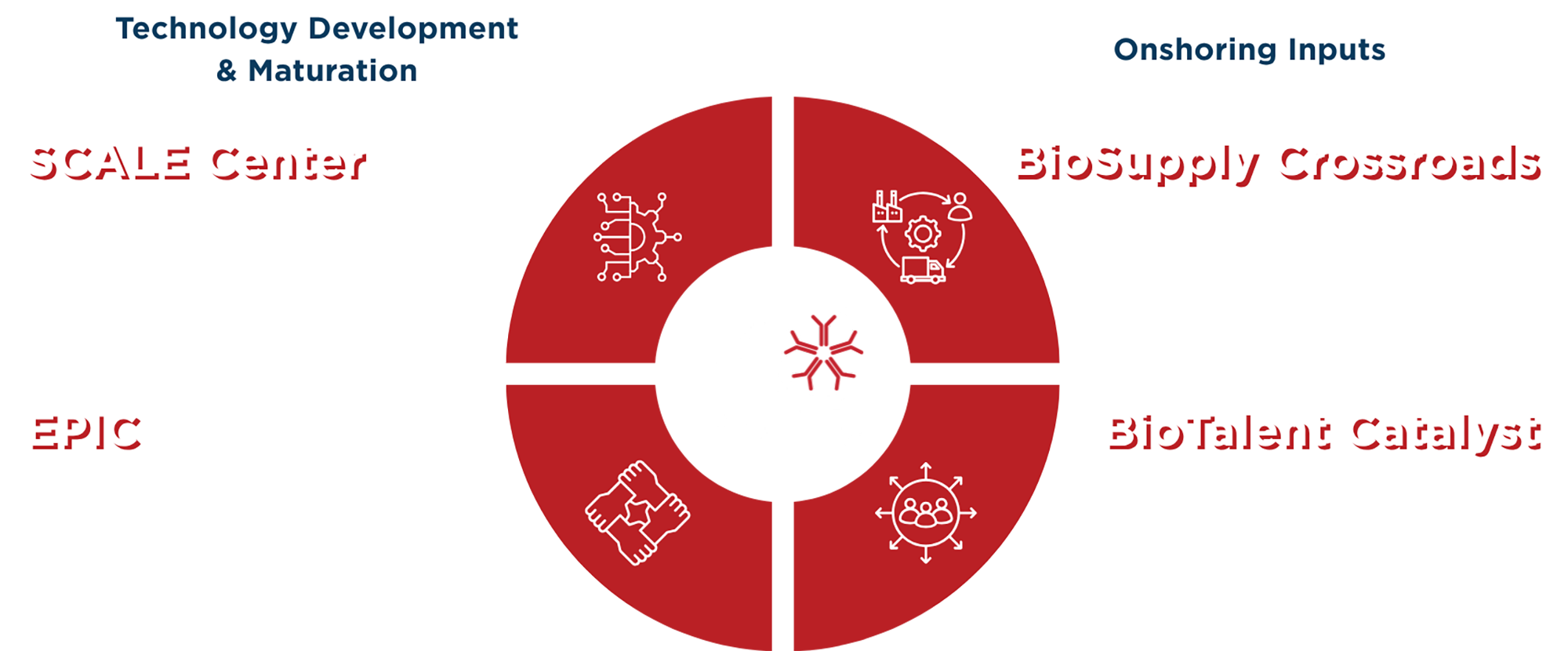
Scale Center EPIC BioSupply Crossroads BioTalent Catalyst
The KC BioHub consortium was awarded funding through the Economic Development Administration’s Regional Technology and Innovation Hubs (Tech Hubs) program to accelerate the growth of the region’s biomanufacturing innovation ecosystem. The award reflects the strength of the region’s talent, infrastructure, partnerships, and strategic vision, positioning Kansas City to drive economic growth, strengthen U.S. competitiveness, and grow as a global leader in biomanufacturing.
Learn more about our active projects below.

Lead: MRIGlobal
The SCALE Center (Systems for Commercial Advancement of Large-molecule Engineering), led by MRIGlobal, will establish a regional technology maturation center that will accelerate FDA approval of advanced biomanufacturing process technologies
The SCALE Center will bring new biologics manufacturing approaches out of the lab and into real-world use, helping move innovations into production-ready processes. It will also provide training on modern manufacturing methods, including continuous processing, modular systems, and AI tools.
In coordination with new regional infrastructure, SCALE will operate and activate advanced manufacturing facilities in the Kansas City region. It will also support workforce development by training the scientists and technicians needed to run and advance these systems, building long-term capacity for U.S.-based biologics production.

Lead: KC BioHub
The EPIC (Efficiency in Pharmaceutical Innovation Center), led by KC BioHub, brings together industry leading bioscience and bioservices companies in the Kansas City region to create a connected, full-service hub for domestic drug development and manufacturing.
The United States is increasingly facing global competition in biotechnology, with more drug development and manufacturing work shifting overseas. EPIC responds by strengthening domestic capabilities and offering a coordinated, efficient, U.S.-based alternative for biopharmaceutical services.
EPIC aligns the region’s existing expertise across all stages of drug development and commercialization, and all therapeutic modalities, making it easier for companies to access integrated, end-to-end services locally instead of relying on fragmented or international providers.
The program also supports more efficient contracting and collaboration across firms, helps qualify and connect partners, and promotes the region as a strong domestic option for biomanufacturing and bioservices.
Lead: Kansas Manufacturing Solutions
The BioSupply Crossroads (BSC) component project, led by Kansas Manufacturing Solutions (KMS), strengthens America’s biomanufacturing supply chain by bringing production of critical materials for the bioeconomy back to the United States.
This project expands reliable U.S.-based options by connecting biomanufacturing companies with regional manufacturers that can produce or supply these inputs.
By matching what biomanufacturers need with what local manufacturers can produce, the project makes the supply chain more reliable and less vulnerable to disruption. It also helps regional manufacturers reach new customers and enter new markets by adapting their production to meet these needs.
Lead: KC BioHub
The BioTalent Catalyst (BTC), led by BioNexus KC, builds a stronger biomanufacturing workforce in the Kansas City region by connecting employers, educators, and training programs to better align talent with industry needs.
Many biomanufacturing companies struggle to find workers with the right skills. BTC addresses this by bringing industry and education partners together to identify in-demand skills, improve training programs, and strengthen pathways into high-wage careers.
BTC also expands early career opportunities through high school and college-level biotechnology courses that provide hands-on training and industry-recognized credentials, helping students prepare for careers in biomanufacturing.
In addition, BTC supports advanced training for both new and current workers in areas such as automation, robotics, and modern manufacturing technologies, helping the regional workforce keep pace with industry innovation.