
Six hundred years ago, a great maritime general launched a series of visionary voyages to discover new lands and expand trade. His expeditions reshaped the known world and inspired his empire to invest in the technology that made them possible—shipbuilding. Out of that investment came the most advanced fleet in human history.
His name was Zheng He, the great Chinese admiral whose “treasure voyages” to India and Africa predated Columbus by eighty years and Drake’s circumnavigation by nearly two centuries. His ships—some nearly four hundred feet long—brought back gold, spices, ivory, and even a giraffe presented to the emperor as a symbol of global reach. Those voyages made the Ming Dynasty a superpower that controlled trade across the Indian Ocean.

Recreation of the Treasure Fleet Ward 吴德赛. Chinese Whispers: Zheng He’s Treasure Ships in the context of Chinese Maritime Policy in the Ming Dynasty.
And then, almost overnight, it ended. After Zheng He’s death, court officials called the voyages extravagant, ordered the shipyards dismantled, and destroyed the naval records. Within decades, China’s shipbuilding expertise vanished. By the time Europe began its own age of exploration, China’s fleets—and its strategic reach—were gone.
That loss proved devastating. Centuries later, China’s outdated navy was one reason Britain dominated in the Opium Wars—a period the Chinese still call their century of humiliation.
When China stopped building, it didn’t just withdraw; it lost the ability to engage the world from a position of strength. The Ming court dismantled the most advanced industrial base on Earth—and in doing so, it dismantled its future.
Six centuries later, the parallel is hard to miss. The United States faces the same temptation: to assume that today’s leadership guarantees tomorrow’s power. America’s modern shipyards are our labs, our factories, our biomanufacturing plants. We once led the world in building what we invented; now we’ve allowed much of that capacity to drift offshore.
For decades, we treated offshoring as strategy—assuming efficiency would always equal strength. But outsourcing hasn’t just improved productivity; it has reduced our choices. And when you lose choice, you don’t have markets anymore—you have monopolies.
Biomanufacturing is our generation’s shipyard—where our ability to build meets our ability to lead. If we can’t make what we invent, we won’t just lose an industry; we’ll lose the capacity to shape our future.
When China, our modern rival, learned that lesson, it changed its mindset. Today, it’s often said that the Chinese invest in centuries while we invest in cycles. Their strategy has been patient, deliberate, and centralized; while ours has been impulsive, episodic, and partisan. Only time will tell whether our current burst of industrial policy investment will yield a lasting foundation.
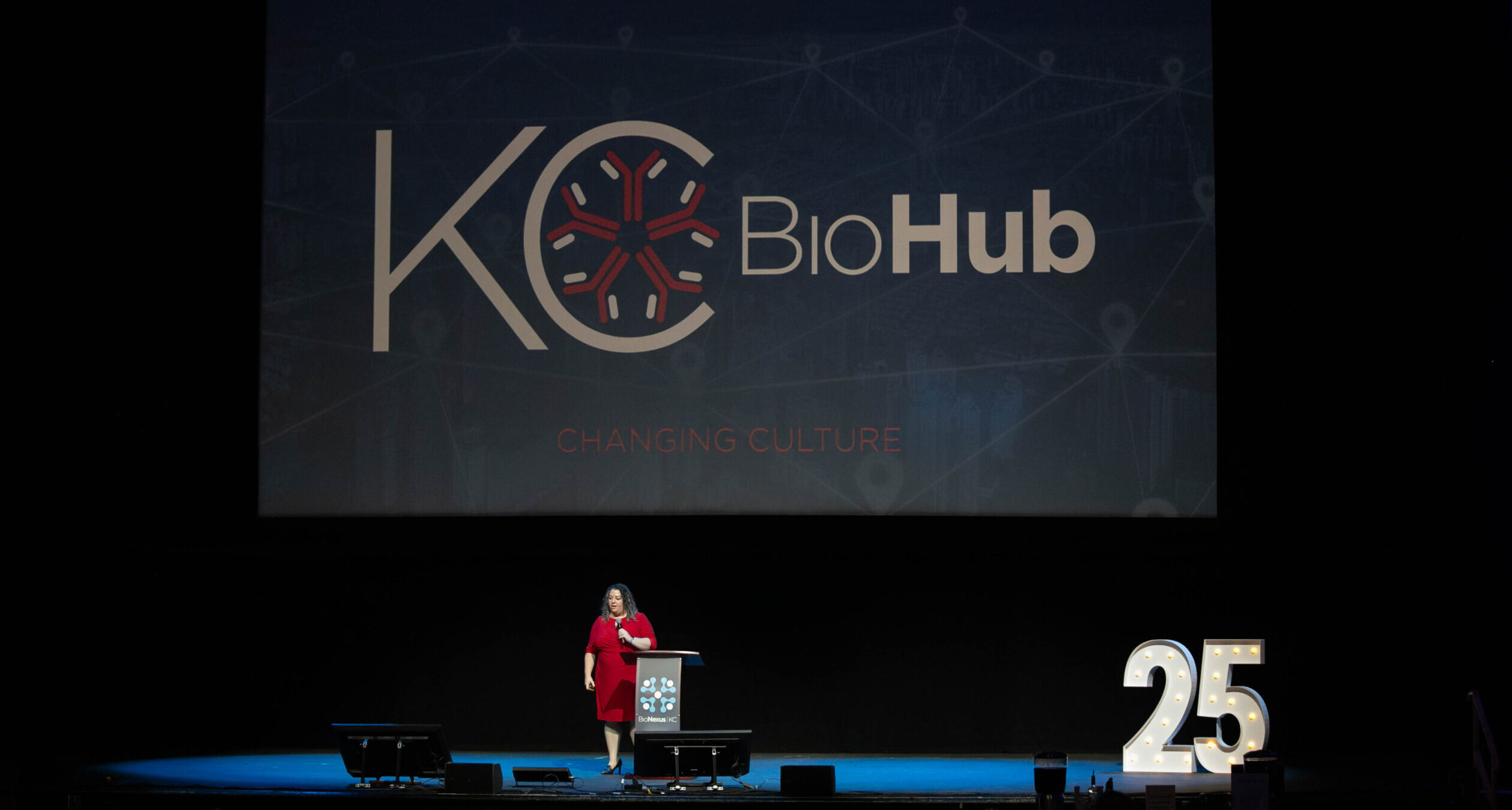
That work now rests on the shoulders of regions like ours. We must build the infrastructure and systems necessary to sustain global leadership in ways Washington cannot. This is what Bruce Katz meant when he stood on this stage last year and called for a new civic operating system. We must think of efforts like the KC BioHub as critical infrastructure, not as “unnecessary extravagances.” We can’t keep waiting for “de-risked” opportunities. If we do, another region—Indianapolis, Central Virginia, Madison—will take our place.
Because the future of American power will be decided regionally.
Since the CHIPS and Science Act of 2022, the new industrial policy has shifted agency to regions. These investments fuel America’s edge in critical technologies while countering the concentration of research and capital on the coasts—what economists call “agglomeration.”
Nationally, we’ve optimized for invention. But those stalwart sources of research funding have been eroded today.
That’s a challenge—but for Kansas City, it’s also an opportunity. The future of American innovation will be determined not by how much science we fund in Washington, but by how much capacity we build in places like KC.
That regional innovation capacity – is the ability to turn discovery into durable advantage—to move ideas from lab benches to biomanufacturing facilities, from research grants to good jobs.
We have a window of opportunity to build that advantage here, as every enduring industry has been built here—through alignment, not by accident. What we need is shared purpose: a laser focus on an industry, like biologics, that we can win by connecting discovery to production, raising capital to scale, and strengthening our regional superpower—the ability to manufacture what we invent.
That’s what the KC BioHub is advancing—a coordinated pipeline that turns strong, but disconnected assets into a single value chain, growing the pie for all.
But we can’t compete globally without capacity—and we’ve fallen far behind.
The United States invented biotechnology. We pioneered recombinant DNA, monoclonal antibodies, CAR-T therapy, mRNA vaccines—entire new frontiers of medicine that changed the way we prevent, treat, and even cure disease. But over time, we offshored the ability to make them—often to our largest geopolitical rival. in doing so, we’ve also jeopardized our leadership in biotech innovation.
Across the drug development cycle, China is moving dominate the process of manufacturing, developing, and even discovery new drugs on a global scale. Today, China holds 70% of the world’s fermentation-based biomanufacturing capacity. When it comes to guiding drugs through the regulatory process, China has supported massive, state-subsidized bioservices firms that offer unbeatable efficiency and speed, while quietly stealing American IP. These firms are so prevalent that today, four out of five American biotech companies have a contract with one. We’re even dependent on China for the 80% of the ingredients in essential medicines. This includes not just the active ingredients and molecules, but also the excipients, the packaging, and even the instruments used to make them.
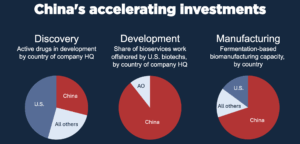
Today, China is finally turning its sights on the element that we value most in the west: the development of innovative medicines.
Over the past ten years, through aggressive regulatory reforms and investment in clinical trial infrastructure, China has risen to rival the U.S. in terms of innovation capacity, originating 37% the new medicines approved by global regulators last year. We have every indication that, given the pace of their growth, they have already overtaken the U.S. as the single largest originator of new medicines approved globally.
The Chinese have demonstrated the power of self-reliance and long-term strategic investment—a lesson we seem to have forgotten. This has led to an unwise and untenable dependence on our greatest geopolitical rival to realize the innovations we produce. During the pandemic, we discovered the hard way what happens when we don’t control the means of production for life-saving therapies. Tomorrow, that same insecurity could lead to an even more catastrophic disruption—one that could easily be intentional.
Our dependence on China is no longer an unfortunate “externality” of a greater economic good—it’s a strategic effort by the Chinese to gain the ability to drive our country to its knees, whenever they choose to. Across many industries: semiconductors, critical minerals, and of course biomanufacturing, we are in the process of learning the painful lesson that China learned 600 years ago.
Kansas City has the raw inputs to compete with even the strongest global ecosystem. We have four R1 universities—together, the size of a top-25 research institution. We have more than 150 bioservices firms—one of the nation’s largest clusters of these firms. We lead the world in manufacturing of biologics for animal health and have the opportunity to do the same in human health. Within each of these industries, players often compete for the same projects instead of building shared capacity. Even the greatest assets lose power when they compete instead of combine.

Imagine if Zheng He had relied on a patchwork of rival shipbuilders to construct his fleet. Each might have prospered for a season, but none could have built an empire. Coordination—not competition—is how capacity scales.
Now, I’m not advocating a collectivist system. We can’t—and shouldn’t—try to out-China China. It is also counter to our American ideals. But we can recognize that coordination doesn’t weaken capitalism; it strengthens it. We’re stuck in a prisoner’s dilemma—each of us better off cooperating but afraid to move first. As any economist will tell you, the way out is through the promise of repeated games: aligning investments, sharing infrastructure, and commercializing faster together. That’s how we grow the pie.
We know that the next decade will bring an AI-powered explosion of drug development and entrepreneurial opportunities. We must build our regional capacity to meet that surge. If we can find the courage to collaborate rather than compete, it will become Kansas City’s defining strength for decades.
Becoming self-sufficient in this way doesn’t mean turning inward or isolating ourselves. It means restoring our ability to participate in a global economy—from a position of strength. It means funding this infrastructure as critical, not charitable. It means building a region—and a nation—where scientists, manufacturers, and investors move as one value chain, not as separate industries.
Self-sufficiency is not isolation. It’s what makes collaboration and global impact possible.
So what does it take to move from here to there?
The capacity we need to build in order to change is civic, not just technical.
America’s edge has never been just its science—it’s been its systems: the way government, business, universities, and philanthropy work together to turn ideas into impact. During World War II, that system built the “arsenal of democracy.” During the space race, it built NASA’s supply chains. In our lifetime, it sequenced the human genome. But in recent decades, that system has frayed, declined, and in some cases, been dismantled.
50 years ago, innovation came from the largest private companies and wealthy oddballs—the Bell Labs and Howard Hughes of the world. 25 years ago, it came from a decentralized, somewhat chaotic, but powerful network of research universities and federal labs. But where will it come from tomorrow?
Here in Kansas City, we’re building a new model of networked innovation capacity—where biomanufacturing innovation advances through partnerships among universities, federal labs, private firms, startups, and civic institutions. The KC BioHub is not a brand; it’s a bridge—a civic infrastructure for the bioeconomy connecting research, industry, and leadership around shared execution, not just shared enthusiasm.
Regions that win the next century won’t be those with the most ideas or the biggest grants—the truth is that these are outputs, not inputs. The winners will be the ones who can move as one.
This is difficult, unglamorous work—grant writing, program delivery, stakeholder coordination—but it’s necessary. Because progress in biomanufacturing, as in so many critical technology areas, requires collaboration across higher education, philanthropy, finance, government, and industry.
That’s what civic maturity looks like— a mutual recognition that all viewpoints are important, though we all might see success somewhat differently. And it’s what this region is beginning to show the nation: how to grow strategically, collaboratively, and as part of a larger whole.
For most of our history, America’s greatness has come from the people who built what mattered most—railroads, airplanes, vaccines, cures. Kansas City has always been part of that story. We connected the coasts by rail. We built engines for the Arsenal of Democracy. And today, we can build the infrastructure for the next American frontier: the bioeconomy.
That work will require more than new facilities or programs. It will take new civic muscles—habits of collaboration, long-term vision, and shared commitment. As the technical capability accelerates, trust and relationships will become the gating factor. By building the critical infrastructure for collaboration today, we’ll be ready to meet the moment.
That is to say, the future of American power won’t be written in code, built in real estate, or leveraged in capital alone. It will be cultured, fermented, and grown right here at home by the dynamic, living system that we build together.
And if we do this right—if we build capacity that lasts—then our region won’t just be part of America’s next chapter. We will help write it.