
By: Nazish Jeffery
The National Security Commission on Emerging Biotechnology (NSCEB) was established by Congress to assess how advances in biotechnology affect U.S. national security and economic competitiveness. In April 2025, the Commission released its comprehensive report, outlining 49 policy recommendations aimed at strengthening the U.S. biotechnology ecosystem. Since its release, several of these recommendations have been introduced in Congress as standalone legislation, and many biotechnology-related provisions spanning defense and intelligence authorities have now been operationalized through the FY2026 National Defense Authorization Act (NDAA).
Importantly, the FY2026 NDAA represents one of the first major legislative vehicles translating NSCEB’s recommendations into operational federal policy, particularly around national security, industrial capacity, and supply chain resilience. In parallel, Congress is already actively marking up the FY2027 NDAA, which includes additional biotechnology provisions, underscoring that this is not a one-time policy moment but an accelerating legislative trajectory.
Within this broader landscape, the FY2026 NDAA marks one of the most consequential statutory steps in elevating biotechnology as a national security priority. The legislation embeds biotechnology more deeply into defense and intelligence planning, signaling durable federal interest beyond short-term initiatives, and positions biotechnology as a strategic capability rather than a niche research area. For regional ecosystems like Kansas City, this shift also signals growing federal recognition that biotechnology capacity must extend beyond traditional coastal hubs toward distributed “microbioeconomies” capable of supporting translational research, biomanufacturing, workforce development, and resilient domestic supply chains.
At the same time, while the NDAA meaningfully elevates biotechnology within defense structures, its framing remains largely anchored in defense and intelligence metrics. This creates that biotechnology policy is treated primarily as a national security cost center to be optimized, rather than a full-spectrum economic and industrial capability. Without broader alignment to commercial scaling, workforce expansion, and regulatory modernization, defense-led investments risk functioning as a partial “bandaid” – moving funding and prioritization within the system, rather than fully building the underlying domestic bioindustrial base needed for long-term competitiveness.
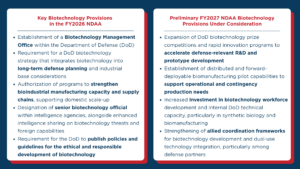
Taken together, these anticipated provisions suggest a continued institutionalization of biotechnology within the DoD and allied defense ecosystems, with increasing emphasis on innovation acceleration, operational readiness, and supply chain resilience. While this deepens the federal government’s structural engagement with biotechnology, the framing remains primarily oriented toward defense utility and strategic competition, further embedding biotechnology within national security architectures rather than advancing a fully unified approach to domestic commercialization, regulatory alignment, and industrial scale-up.
Historically, the DoD’s engagement with biology has been largely confined to biodefense, with limited investment in biotechnology as a broader strategic capability. Only in the past decade has DoD begun integrating biotechnology into warfighting and national security planning, a transition that remains ongoing and consistent with U.S. commitments under the Biological Weapons Convention. The inclusion of NSCEB-driven biotechnology provisions in the FY2026 NDAA represents an initial step toward correcting this fragmentation by laying the groundwork for a more coherent biotechnology strategy within the Department.
A well-articulated DoD biotechnology strategy would help clarify which biotechnologies matter to national security, on what timelines, and with what performance expectations. In doing so, it could bridge a persistent gap between early-stage research outputs and downstream portfolio decisions that shape industrial scale-up. For firms and researchers alike, clearer demand signals and priority domains enable more rational capital allocation, reduce transaction costs associated with pursuing ambiguous opportunities, and support long-term planning across R&D and commercialization. This approach aligns with longstanding expert calls for national-level prioritization frameworks that link strategic intent to measurable capacity goals. By 2027, success would not simply mean that biotechnology language remains embedded within the NDAA, but that these authorities have translated into coordinated programs, procurement pathways, and regional infrastructure investment capable of driving real industrial growth.
Beyond internal planning, a formalized strategy could also recalibrate how DoD engages with external stakeholders, including academia, startups, and established firms, while explicitly embedding clear standards for the ethical and responsible development and use of biotechnology. By delineating development phases, readiness criteria, and evaluation metrics, DoD could improve the predictability and quality of public-private engagement. Similarly, industry participation would be grounded in clearer expectations around risk, benefit, and scale, ultimately improving transparency and trust across the innovation ecosystem. For regional ecosystems, that predictability could materially shape how universities, manufacturers, startups, and medical institutions organize around long-term commercialization and workforce strategies.
Integrating biomanufacturing scale-up into DoD’s biotechnology strategy could further reduce structural barriers that have historically constrained U.S. industrial capacity. For companies operating at the intersection of biology and manufacturing, clarity around when and how defense demand translates into scale commitments, whether through advance market signals, contract structures, or cost-sharing mechanisms, could materially alter investment calculus. Such signals would help mobilize private capital toward capabilities of high national importance that currently face significant market uncertainty. This dynamic is especially relevant for regions like Kansas City, where advanced manufacturing assets, logistics infrastructure, and growing life science capabilities create opportunities to participate in growing national bioindustrial supply chains.
Strategic Considerations, Opportunities, & Gaps
The elevation of biotechnology within the FY2026 NDAA reflects a broader, bipartisan trajectory. A long list of actions, including the Biden Administration’s Bioeconomy Executive Order, the creation of the NSCEB, the establishment of the BIOTech Caucus in the 119th Congress, and continued executive attention across administrations, underscore growing consensus that biotechnology is central to long-term economic competitiveness and national security. As biotechnology policy increasingly intersects with defense, manufacturing, agriculture, and commerce, congressional committee assignments will also play a growing role in shaping how these priorities advance. For regional ecosystems, engagement with delegation members serving on Armed Services, Appropriations, Agriculture, Commerce, and Intelligence Committees may become increasingly important for advancing regional biotechnology priorities tied to regional growth.
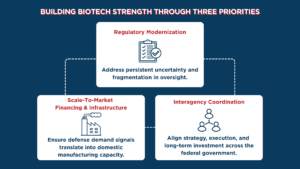
At the same time, translating this momentum into long-term capability will require attention to three interrelated priorities:
- Regulatory modernization to address persistent uncertainty and fragmentation in oversight.
- Scale-to-market financing and infrastructure to ensure defense demand signals translate into domestic manufacturing capacity.
- Interagency coordination to align strategy, execution, and long-term investment across the federal government.
The FY2026 NDAA embeds biotechnology more firmly within defense and intelligence planning. However, its defense-focused authorities leave important structural questions unresolved. The FY2027 markups build on this trajectory, signalling continued emphasis on defense-led biotechnology innovation while still reinforcing rather than resolving the underlying challenge of translating defense-driven experimentation into sustained industrial scale and a broader, integrated bioeconomy strategy.
Regulatory Modernization
Since the NDAA operates within a defense authorization framework, it does not directly address regulatory reform or broader commercial market clarity. Yet regulatory uncertainty and overlapping agency jurisdictions remain persistent barriers within the U.S. bioeconomy. Without complementary efforts to modernize and harmonize regulatory pathways, new defense authorities may generate demand signals that outpace the system’s ability to scale reliably and predictably. Clearer guidance and streamlined approval processes could help companies, academic labs, and startups navigate regulatory requirements more efficiently, reducing time-to-market and lowering barriers to entry for emerging technologies.
The FY2027 NDAA’s emphasis on rapid innovation programs and prize competitions further heightens the importance of regulatory responsiveness, as faster-cycle defense innovation pipelines will increasingly require parallel improvements in regulatory coordination and review capacity to avoid downstream bottlenecks.
Scale-to-Market Challenges
The authorization of programs to strengthen bioindustrial manufacturing and supply chains has the potential to support scale-up across the innovation pipeline, particularly for academic spinouts and emerging firms navigating the lab-to-market transition. However, bridging the “valley of death” requires sustained financing mechanisms and infrastructure beyond procurement alone. Initiatives such as the Office of Strategic Capital were designed to alleviate scale-up constraints for emerging technologies, including biotechnology, but require sustained reauthorization and funding. More explicit linkages between defense demand and broader capital formation would help ensure that early-stage breakthroughs translate into resilient domestic capacity. By 2027, a meaningful indicator of success would be the emergence of regionally distributed attributes like capacity and workforce pipelines capable of supporting national biotechnology priorities at commercial scale.
The FY2027 NDAA’s proposals for distributed and forward-deployable biomanufacturing capabilities underscore this shift toward physical scale infrastructure, making domestic production capacity a central constraint that policy must address.
Interagency Coordination
While the NDAA strengthens biotechnology capacity within DoD and the intelligence community, it does not establish a centralized, government-wide coordination mechanism. As a result, biotechnology remains distributed across agencies with differing mandates, funding streams, and regulatory authorities. Absent a durable whole-of-government structure to align priorities and execution, progress risks remaining uneven and siloed. Establishing mechanisms for cross-agency communication, shared data standards, and coordinated strategic planning could help ensure that investments in defense biotechnology also reinforce broader economic, research, and national security objectives.
Implementation Tradeoffs
The interaction between the NDAA’s biotechnology provisions and legislation such as the BIOSECURE Act reinforces the importance of strengthening domestic biotechnology capacity and supply chain resilience across the U.S. bioeconomy. Rather than framing this dynamic primarily as a tradeoff between openness and restriction, it highlights a broader structural imperative: the need to ensure that critical inputs, manufacturing capabilities, and innovation partnerships are reliably anchored within a secure and scalable domestic ecosystem.
As these provisions are implemented through rulemaking, contracting, and agency guidance, the key policy challenge will be accelerating domestic readiness across both public and private actors. This includes ensuring that universities, startups, and manufacturers can access stable supply chains, predictable regulatory pathways, and clear mechanisms for scaling production within the U.S. Strengthening these foundational capabilities is essential to ensuring that national security objectives translate into sustained industrial growth and durable domestic capacity rather than fragmented or reactive interventions. Ecosystems like Kansas City illustrate this approach in practice, where coordinated development of research assets, manufacturing infrastructure, workforce pipelines, and commercialization support helps operationalize federal biotechnology priorities through institutions such as KC BioHub.
The NDAA represents a significant step in translating the NSCEB’s recommendations into statutory action, embedding biotechnology more firmly within defense and intelligence planning, institutional structures, and threats assessment. It signals that biotechnology is no longer peripheral to national security policy, but an emerging strategic capability warranting sustained attention.
For microbioeconomies, the implications extend well beyond federal defense planning. The next phase will depend on whether federal, state, and regional actors can translate strategic intent into sustained execution capable of building a more distributed and resilient American bioeconomy. Regions able to align research strengths, manufacturing capacity, workforce development, and public-private coordination around emerging federal priorities will likely be best positioned to compete for future investment and national relevance.
Yet the legislation reflects only a partial realization of the broader vision. By advancing biotechnology primarily through defense-specific authorities, the NDAA strengthens internal coordination and demand signaling within DoD while leaving unresolved challenges related to regulatory modernization, scale-to-market infrastructure, and whole-of-government alignment. Early FY2027 NDAA markups suggest continued expansion of this strategy, reinforcing rapid innovation mechanisms, distributed biomanufacturing concepts, and workforce development within a defense framing, while still stopping short of a unified bioindustrial strategy that spans civilian and commercial scale.
Ultimately, the central test will be whether these evolving federal signals can be converted into durable, place-based capacity. Regions that successfully integrate research institutions, manufacturing infrastructure, workforce pipelines, and commercialization pathways will be best positioned to operationalize this agenda and convert policy momentum into sustained industrial growth. Ecosystems like Kansas City illustrate how this alignment is beginning to take shape in practice, where coordinated efforts across institutions such as KC BioHub help translate federal biotechnology priorities into tangible capacity-building across the domestic bioeconomy.