


By: Nazish Jeffery
“Congress must empower the National Biopharmaceutical Center of Excellence with formal mechanisms for interagency coordination, shared data frameworks, and clear pathways for translating experimental results into binding regulatory guidance and precedent.”
The National Security Commission on Emerging Biotechnology (NSCEB) showed that biotechnology and biomanufacturing are national priorities. The recent Biomanufacturing Excellence Act of 2025 translates this priority into durable federal infrastructure. Although the legislation remains in committee in both the House & Senate, the strategic concerns that motivated its introduction, including supply chain resilience, domestic manufacturing capacity, and translational scale-up, have only become more urgent as regions across the country invest in biomanufacturing infrastructure and commercialization capacity. Efforts such as the KC BioHub SCALE Center, which aims to provide shared scale-up and commercialization infrastructure for emerging biologics and therapeutics, reflect the growing regional momentum behind many of the act’s core objectives. The act addresses a central weakness in the U.S. innovation system: while it excels at biological discovery, it consistently underinvests in the institutions, standards, and capabilities required to reliably scale domestic production. To combat this, the act proposes the creation of a National Biopharmaceutical Center of Excellence through the National Institutes of Standards and Technology (NIST). For this new center to reliably scale domestic production, it must resolve, rather than reproduce, the challenges that have historically limited biomanufacturing progress:
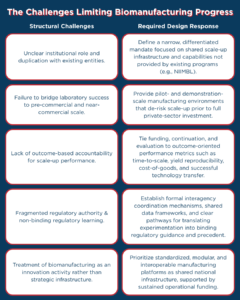
The newly created center would focus on the translational space between laboratory discovery and commercial production, where many U.S. biotechnology efforts stall. Specifically after laboratory proof-of-concept but before full commercial deployment, where biology is validated but processes are not yet sufficiently robust, reproducible, or cost-effective to justify private investment at scale. However, the current act does not yet clearly articulate what unique function the proposed center would perform that cannot be achieved through expanded mandates or targeted reforms within existing institutions. If designed with a clear mandate to support pre-commercial and near-commercial scale experimentation, such as pilot scale and demonstration scale manufacturing, process intensification, and early CGMP integration, the center could provide capabilities that are currently scarce: shared access to advanced manufacturing platforms, early integration of CGMP considerations, and real-world testing of flexible, multi-product processes. The center must avoid duplication and institutional redundancy without functional difference between existing entities, such as NIIMBL. NIIMBL already supports biopharmaceutical manufacturing R&D, workforce training, and industry coordination. Instead, the legislation should encourage a distributed national model that leverages emerging regional hubs with differentiated strengths. KC BioHub’s SCALE Center, for example, reflected many of the same priorities outlined in the act around translational infrastructure, scalable manufacturing capacity, and commercialization support.
In addition, the act would benefit from a sharper and more explicit definition of what success looks like. While its emphasis on advanced manufacturing platforms, CGMP alignment, and workforce development is directionally strong, the proposal does not yet articulate clear accountability mechanisms tied to scale-up outcomes. Instead of repeating past federal manufacturing initiatives’ measurement of progress through participation, reports, or pilot activities, the center should employ indicators that reflect real translational impact, such as reductions in time-to-scale, improvements in yield reproducibility, lower cost-of-goods, or successful technology transfers into domestic production facilities. With this kind of accountability in place, the center could become a powerful mechanism for de-risking biomanufacturing and accelerating deployment. This type of outcome-oriented framework is especially important for emerging biomanufacturing regions like Kansas City that are working to translate research strengths into scalable domestic production capacity.
Congress must empower the center with formal mechanisms for interagency coordination, shared data frameworks, and clear pathways for translating experimental results into binding regulatory guidance and precedent.
The act’s emphasis on regulatory engagement is a genuine area of promise, but one that will require deliberate follow-through to deliver systemic impact. Collaboration with regulators and standards bodies could create meaningful feedback loops, enabling regulatory learning alongside technological development; however, collaboration alone will not modernize regulatory pathways. As the NSCEB has identified, fragmented oversight and unclear interagency authority remain core barriers in the regulatory system. However, the act does not yet specify how the center would generate binding regulatory learning, harmonize standards across agencies, or translate experimentation into enforceable policy change. If these structures are put in place, the center could function not merely as an advisory forum, but as a test bed for modernized regulatory approaches to emerging biomanufacturing platforms. For regions developing translational biomanufacturing infrastructure, clearer federal coordination mechanisms would help ensure regional capabilities can contribute directly to national regulatory modernization efforts.
Finally, the act gestures toward, but does not fully articulate, a vision of biomanufacturing as foundational infrastructure rather than solely a site of innovation. Long-term resilience will depend less on the generation of new ideas and more on sustained investment in standardized, modular, and interoperable production systems, supported by digital bioprocess control, real-time analytics, and platform technologies that reduce reliance on bespoke, product-specific workflows. Accordingly, the center’s mandate and funding priorities should explicitly favor the development, maintenance, and shared use of standardized manufacturing platforms and operational capabilities, rather than primarily supporting novel research or one-off demonstrations. This infrastructure-oriented approach closely mirrors the rationale behind KC BioHub’s emerging biomanufacturing strategy, which emphasizes scalable production capacity, shared infrastructure, and workforce readiness.
If the center prioritizes operational capability and standardization alongside innovation, it could help shift the U.S. biomanufacturing ecosystem toward greater scalability, flexibility, and responsiveness. Without that emphasis, however, there is a risk that the center becomes redundant or ineffective, ultimately limiting its ability to deliver the resilience and rapid response capacity that its national security framing demands.
Overall, the Biomanufacturing Excellence Act represents a credible and necessary step toward strengthening U.S. biomanufacturing capacity, but it is not self-executing. Its success will depend on whether Congress and implementing agencies are willing to make deliberate and sometimes difficult design choices: clearly defining institutional roles to avoid duplication, tying resources to measurable, outcome-based performance, empowering regulatory experimentation with real authority, and treating manufacturing capacity as strategic infrastructure rather than a byproduct of research excellence. As Congress evaluates the future of the legislation, it should prioritize partnerships with emerging regional ecosystems already building the translational and scale-up infrastructure the act envisions. Efforts like KC BioHub’s Tech Hub strategy and SCALE Center demonstrate how shared manufacturing infrastructure, commercialization support, and advanced biomanufacturing capacity can help operationalize national biomanufacturing priorities at the regional level.