

By: Nazish Jeffery
The United States (U.S.) has spent more than two decades building its advanced biotechnology ecosystem. Federal investment in key areas of development such as scientific research, university-based innovation, and advanced manufacturing have positioned the country as a global leader in biotechnology discovery. Across health, agriculture, energy, and industrial applications, the U.S. continues to generate a steady pipeline of scientific breakthroughs supported by world-class research institutions and a deep venture ecosystem.
Yet, despite this leadership in innovation, a structural constraint has become increasingly visible. The U.S. is highly effective at generating biotechnology discoveries and innovation, but significantly less effective at scaling them into commercial production. Across sectors, promising technologies routinely demonstrate technical feasibility in laboratory and pilot environments but encounter persistent barriers when transitioning into demonstration facilities, commercial manufacturing, and sustained industrial deployment. With time, the central question has shifted away from asking if the U.S. can innovate, but whether it can consistently translate innovation into scalable industrial capacity.
This constraint is increasingly visible at the regional level, where organizations such as KC BioHub in Kansas City are directly confronting the gap between federal biotechnology investment and the infrastructure required for scale-up. Rather than a lack of innovation or capital, the challenge emerges as a fragmentation problem: promising technologies, regional assets, and federal programs exist in parallel but are not consistently connected into coherent commercialization pathways.
Recent legislation, including H.R.7936: Bioindustrial Scale-Up for Supply Chains and Energy Resiliency Act of 2026 (the Act), reflects an emerging recognition of this challenge. The bill amends the Energy Policy Act of 2005 to support biotechnology development, demonstration, and commercialization efforts that enhance energy resiliency. It authorizes pilot and demonstration-scale infrastructure, technology maturation facilities, workforce development activities, and coordination mechanisms intended to bridge the gap between research outputs and deployable industrial systems. While anchored in energy policy, its broader significance lies in the shift it represents toward treating biotechnology as infrastructure that must be actively scaled rather than passively supported through research incentives alone. This evolution marks an inflection point in federal bioeconomy policy.
The Scale-Up Problem is Now the Defining Constraint of the Bioeconomy
The U.S. bioeconomy is increasingly defined not by its ability to generate innovation, but by its ability to scale it. This shift is visible across regions where biotechnology ecosystems are beginning to confront the limits of fragmented infrastructure.
In Kansas City, KC BioHub has emerged as a coordination mechanism aligning regional manufacturing assets, agricultural inputs, and federal program opportunities into coherent scale-up pathways. This effort reflects a broader national pattern in which regional organizations are increasingly responsible for addressing integration challenges that sit between federal programs and industrial deployment. All while taking on larger, more expensive, and increasingly interdisciplinary complexities that these technologies bring, such as finding funding for CAPEX that serves multiple biotechnology industries.
At a national level, this constraint is often described as the “valley of death” between R&D and commercialization. In practice, however, it becomes apparent that it is both a funding gap and a systems integration gap. Technologies can fail at many points along the commercialization pipeline, including because capital is unavailable, but they also can stall because the infrastructure required to support scale-up is fragmented across institutions, agencies, and geographies.
For example, a company may have a validated biological process but lack access to demonstration-scale facilities needed to show viability within the market. It may secure capital but face uncertainty in feedstock availability or logistics infrastructure. It may reach early production but encounter constraints in energy capacity or workforce specialization. These challenges are interdependent, which means solving them requires more than isolated investments. This is why scale-up increasingly functions as a coordination problem rather than a purely financial or scientific one. Competitiveness in the next phase of the bioeconomy will depend less on who produces the most innovation and more on who builds the most coherent systems for industrialization.
The Bioindustrial Scale-Up for Supply Chains and Energy Resiliency Act Signals a Structural Shift in Federal Thinking
One of the major challenges that the U.S. bioeconomy and biotechnology ecosystem faces is the inherent silos that have formed within these industries. The Bioindustrial Scale-Up for Supply Chains and Energy Resiliency Act reflects a growing recognition that biotechnology development is inseparable from energy systems and industrial infrastructure, acknowledging the interdisciplinary nature of biotechnology. By embedding biotechnology within the Energy Policy Act framework, the bill explicitly connects biological production to national energy resilience objectives, signaling that biomanufacturing is increasingly viewed as part of critical infrastructure rather than a peripheral innovation sector.
The bill’s emphasis on pilot-scale facilities, demonstration projects, and technology maturation mechanisms reflects an understanding that the primary barrier to commercialization is not invention but scale-up capacity. Biological production systems require extended periods of process development, infrastructure investment, and operational refinement before they can achieve commercial viability. These requirements extend beyond traditional research funding structures and into the domain of industrial planning.
What marks the Act significant is not the creation of new programs, but the shift in underlying logic. It reflects a federal policy environment that is beginning to treat biotechnology as a system that must be built, not just a field that must be funded.
The U.S. Does Not Lack Programs. It Lacks a Scale-Up Architecture.
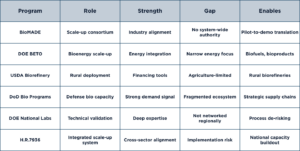
Federal biotechnology investment in the U.S. is already substantial, spanning multiple agencies and mission domains. The Department of Energy (DOE) advances bioenergy development and demonstration pathways, USDA supports agricultural integration and biorefinery deployment, the Department of Defense (DoD) drives strategic biomanufacturing capacity tied to national security priorities, and national laboratories provide deep technical validation and process development expertise. Industry consortia, such as BioMADE, support manufacturing transition pathways that connect research outputs to industrial applications.
Despite this breadth of activity, these efforts were not designed as components of a unified system. They operate across different mandates, funding structures, and operational logics, which results in a commercialization landscape where access to infrastructure, funding, and technical support is distributed but not integrated, ultimately furthering the natural silos that have developed over time. Technologies moving through the system encounter discontinuities between programs rather than continuity across them. The structural implication of this fragmentation is that the U.S. has built significant capacity across individual components of the bioeconomy without yet developing a mechanism that ensures continuity between them which can lead to missed opportunities for advancement and creating a competitive marketplace for these products.
Regional Microbioeconomies are the Missing Execution Layer
Biotechnology scale-up is ultimately constrained by physical systems rather than purely informational or financial ones. Feedstock availability, energy systems, transportation infrastructure, workforce distribution, and manufacturing capacity vary significantly across regions, which means that industrial biotechnology cannot scale uniformly at the national level. These constraints are inherently spatial and require regional coordination to resolve.
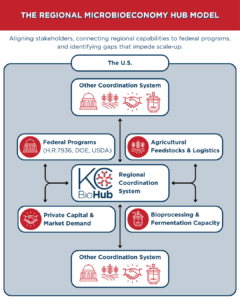
Regional bioeconomies, or microbioeconomies, are emerging as the functional response to this constraint. They operate as integrated ecosystems that connect research institutions, industrial assets, workforce pipelines, logistic systems, and coordination mechanisms into a coherent platform for scale-up. Their role is not to replace federal programs or private investment but to provide the integration layer that allows these elements to function as a system rather than as isolated inputs.
In practice, regional ecosystems are becoming the operational interface between national strategy and industrial execution. Federal programs define priorities and provide capital, but regional systems determine whether technologies can move through commercialization pathways with sufficient continuity to reach deployment.
Kansas City illustrates how these dynamics converge in real-world settings where scale-up constraints are no longer theoretical. The region combines deep expertise in animal health, a strong agricultural production base, advanced manufacturing capacity, and one of the most connected logistics networks in the U.S. These elements collectively create a structural foundation for industrial biotechnology because they link feedstock availability, production capacity, and distribution infrastructure within a single geographic system.
The region operates within a broader agricultural production corridor that connects biomass generation, processing infrastructure, transportation networks, and manufacturing systems. This corridor reduces friction across the production chain by shortening the distance between feedstock availability and industrial processing capacity, a factor that becomes increasingly important as biotechnology shifts toward bio-based chemicals, fermentation-derived materials, and other industrial applications that require consistent input flows at scale.
With this system, KC BioHub functions as a coordination mechanism that works across institutional and industrial boundaries that traditionally remain separate. Its role is to align stakeholders, connect regional capabilities to federal programs, and identify gaps that impede scale-up. This coordination function becomes increasingly important as biotechnology production systems become more distributed and dependent on interoperability across facilities, partners, and supply chains.
The region is also developing capabilities in fermentation and bioprocessing that align with next-generation industrial biotechnology applications. These capabilities are embedded within an industrial environment that is experienced in scaled production systems, which distinguishes it from clusters focused primarily on early-stage innovation. Emerging efforts such as Ronawk’s BioOS further underscore the importance of standardized operating frameworks that enable interoperability across biological production systems, reinforcing the need for coordination mechanisms that extend beyond individual facilities.
Kansas City represents an early test of whether regional ecosystems can function as execution layers for national bioeconomy strategy. Its significance lies in demonstrating how coordination challenges manifest in practice and how they may be addressed through regional alignment rather than solely through federal program expansion.
Policy Actions and What Success Requires
The next phase of U.S. bioeconomy policy will be defined less by the creation of new programs and more by whether existing investments function as a coordinated system for scale-up. Federal agencies already support complementary elements of biotechnology development, yet these efforts remain structurally disconnected across energy, agriculture, defense, and manufacturing domains. The core requirement is a shift from program proliferation toward coordination of scale-up systems that can move technologies consistently from pilot validation to commercial deployment.
That shift begins with recognizing scale-up as a cross-system integration challenge rather than a linear funding pipeline. A practical first step is establishing cross-agency alignment mechanisms that treat pilot infrastructure, demonstration capacity, and commercialization pathways as connected stages of a single national capability. Without this layer, even well-designed programs will continue to produce fragmented outcomes that fail to translate into durable industrial capacity.
Standardized transition metrics are equally important. Today, the thresholds between pilot, demonstration, and commercial scale remain inconsistently defined, creating variability in how readiness is assessed across agencies, investors, and regional partners. Clearer definitions would reduce friction in technology transfer and improve alignment in capital-intensive sectors such as industrial biomanufacturing.
Energy integration is central to this architecture. Biotechnology scale-up is increasingly constrained by energy availability and infrastructure compatibility, particularly for continuous industrial processes such as fermentation. Treating energy policy and industrial biotechnology policy as separate domains creates misalignment at the exact point where scale-up becomes most capital intensive. Aligning these systems would remove one of the most persistent bottlenecks in deployment.
Regional coordination mechanisms also require explicit support. Models such as KC BioHub illustrate how regional entities can function as translation layers between federal programs and industrial execution by aligning infrastructure, stakeholders, and commercialization pathways within a defined geography. Their value lies in reducing fragmentation, not duplicating federal efforts.
Finally, scale-up depends on incentives for replicability and process standardization. As biotechnology production becomes more distributed, interoperability across facilities becomes essential. Without standardized process frameworks, each deployment becomes bespoke, increasing cost and limiting scalability. Across these priorities, the central point remains consistent: scale-up is not constrained by funding, but by systems integration across programs, infrastructure, and regions.
What Success Looks Like & The Tradeoffs Ahead
A scaled U.S. bioeconomy will be defined by functioning regional bioindustrial ecosystems capable of translating biotechnology discovery into predictable industrial output. Success means reliable pathways from pilot to demonstration to commercial scale, where companies and public partners operate within a coherent system rather than a fragmented set of programs.
Federal agencies must function as a connected system rather than parallel lanes of activity, with energy, agriculture, defense, and manufacturing investments aligned around shared scale-up requirements. Regional hubs will need to operate as translation layers that connect policy intent to production reality, ensuring that federal investment becomes integrated industrial capacity.
The risks are structural. Without integration, overlapping programs can increase complexity without improving outcomes. Infrastructure investments may underperform if regional coordination is weak. Lack of standardization across agencies can slow deployment, while uneven regional capacity may widen disparities in bioindustrial development. Energy infrastructure misalignment adds further risk where deployment outpaces system readiness.
The U.S. has already made substantial investments in biotechnology and biomanufacturing. The constraint is no longer expansion, but alignment. Kansas City offers an early test of whether regional microbioeconomies, through mechanisms such as KC BioHub, can convert fragmented federal investment into coordinated industrial capacity and provide a replicable model for national scale-up.