

By: Nazish Jeffery
The United States has spent the better part of the last decade building out a national strategy for the bioeconomy. Federal investment has flowed into biomanufacturing capacity, biotechnology research and development, advanced therapeutics, agricultural innovation, and regional innovation ecosystems. These efforts have helped establish biotechnology as a domain of economic competition and national security, reinforced by the National Security Commission on Emerging Biotechnology and a growing recognition across agencies that biological capability is strategically important.
Yet despite this momentum, one of the most important foundations of the bioeconomy has remained structurally underdeveloped. Biological data is the input layer for nearly every major biotechnology application, but it has not been treated as infrastructure in its own right until now. Genomic sequences, phenotypic data, environmental observations, and biodiversity records are what allow researchers to train models, identify targets, engineer organisms, and design interventions.
The policy environment is beginning to reflect this reality. The introduction of the America’s Living Library Act and the Web of Biological Data Act signals an inflection point in how Congress is approaching biological information. Taken together, these efforts suggest an emerging shift from viewing biological information. Taken together, these efforts suggest an emerging shift from viewing biological data as a byproduct of scientific activity to treating it as a strategic national asset. The significance of this shift lies not in the creation of additional datasets alone, but in the possibility that the U.S. is beginning to construct a coherent biological data infrastructure capable of supporting long term scientific and economic competitiveness.
The Structural Problem: Biological Data Without a System
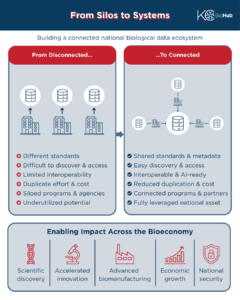
The core challenge facing the bioeconomy is not a lack of biological information. Advances in sequencing technologies, computational biology, and environmental monitoring have made it possible to generate biological data at unprecedented scale. The challenge is that this information is fragmented across institutions, inconsistently formatted, and difficult to integrate across domains. A variety of different stakeholders all maintain valuable datasets, but these systems were not designed to operate as a unified whole. As a result, the value of biological data is often constrained not by its quality, but by its accessibility and interoperability.
This fragmentation has become more consequential as artificial intelligence becomes more deeply embedded in biotechnology. Modern computational systems depend on large, connected, and well structured datasets. When biological information is siloed, its utility declines, even if the underlying data is scientifically robust. Over time, this creates a structural inefficiency in the bioeconomy where data continues to be generated at scale, but its ability to generate downstream innovation is unevenly distributed. The U.S. therefore faces a constraint that is not about production capacity, but about system design and long term usability.
At present, biological data functions more like a collection of parallel archives than an integrated infrastructure layer, resulting in infrastructure that is defined by volume and not connectivity. Without systems that allow biological information to move across institutional boundaries, its economic and scientific value remains partially locked.
The Living Library Act and the Web of Biological Data Act – Two Parts of One System
The America’s Living Library Act addresses one side of this challenge by expanding the supply of biological data derived from public lands. By directing the Department of the Interior to collect and sequence genomic information from animals, plants, fungi, and microbes, the legislation reframes biodiversity as as source of scientific and economic value. Historically, biodiversity policy has been grounded in conservation and environmental stewardship, while biotechnology policy has focused on innovation and commercialization. The America’s Living Library Act begins to bridge these domains by recognizing that biological diversity is itself an input into discovery and technological development.
Ultimately, this legislation expands the role of federal land management systems into generation structured biological datasets that can be used across research domains. In doing so, it strengthens the upstream supply of biological information available to the U.S. bioeconomy and positions biodiversity as a contributor to national innovation capacity rather than solely a conservation priority.
The Web of Biological Data Act addresses a different but complementary constraint. Instead of generating new data, it focuses on the systems required to connect existing biological datasets across federal agencies and research domains. The premise is that biological data becomes significantly more valuable when it can be discovered, accessed, and integrated across institutional boundaries. Across domains, such as genomic data and environmental data, integration of datasets increasingly determines the pace of scientific discovery and innovation.
Taken together, these two legislative efforts define different layers of the same infrastructure problem. The America’s Living Library Act expands on the nation’s biological data assets, while the Web of Biological Data Act strengthens the connective infrastructure required to make those assets usable at scale. One addresses generation, the other addresses integration, but neither is fully effective without the other. This is what makes pairing of these bills analytically significant: they begin to outline a potential architecture for a national biological data system rather than a set of independent programs.
The Risk of Fragmentation and the Requirements for Implementation
The central risk facing both efforts is fragmentation over time. Federal data programs have historically produced valuable datasets that remain difficult to integrate across agencies or sustain over long time horizons. Differences in standards, funding structures, and institutional priorities often lead to systems that evolve independently rather than cohesively. Without deliberate coordination, the U.S. risks repeating this pattern in biological domain, resulting in a proliferation of datasets that are individually useful but collectively limited in their impact.
Avoiding this outcome will require more than technical fixes. It will require institutional alignment across agencies that have historically operated with different mandates and incentives. The challenge is not only how data is structured, but how decisions about data are governed over time. Without a durable framework for coordination, interoperability will remain uneven and dependent on voluntary alignment rather than enforceable standards.
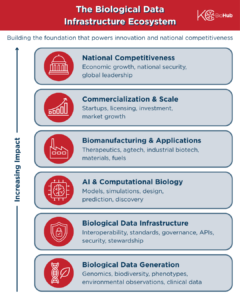
Appropriate governance will be essential to see long-term return on investments. Biological data infrastructure spans multiple agencies, including Interior, Energy, Agriculture, Health and Human Services, and others. A coherent governance structure is necessary to align standards, coordinate infrastructure development, and ensure long term stewardship across these institutions.
Stewardship is equally important. Biological datasets require continuous curation, validation, modernization, and security maintenance. These functions are often underfunded because they are treated as operational costs rather than core infrastructure responsibilities. However, the long term value of biological data depends more on stewardship than on initial generation. Without sustained investment, datasets degrade in usability even if they remain technically accessible.
Finally, interoperability must also be treated as a design requirement rather than a post hoc enhancement. Systems built without shared standards tend to diversify over time in ways that are difficult and costly to reverse. For biological data, this creates compounding inefficiencies as datasets grow in size and complexity. Interoperability should therefore be embedded at the design stage through shared metadata standards, APIs, and access protocols that allow data to move across institutional and disciplinary boundaries. As artificial intelligence becomes more central to biotechnology, fragmented data systems will increasingly become a constraint on innovation and competitiveness.
The significance of the Living Library Act and the Web of Biological Data Act extends beyond biodiversity, genomics, or data governance. What is emerging is a broader shift in how biological information is understood within federal policy. For much of the past decade, bioeconomy strategy has emphasized innovation, commercialization, and production capacity. These remain essential priorities, but they are insufficient on their own. Innovation depends on infrastructure that allows information to accumulate, connect, and retain value over time.
These legislative efforts represent early steps toward defining that infrastructure layer. They suggest a policy environment in which biological data is beginning to be treated with the same seriousness once reserved for transportation networks, energy systems, and digital infrastructure. If implemented effectively, they could help establish the foundation of a national biological data ecosystem capable of supporting biotechnology and long term economic competitiveness.
The U.S., however, is not yet operating within such a system, but it is in the early stages of building one. Whether these efforts become the foundation of a coherent infrastructure layer or remain a collection of isolated programs will depend on implementation choices around governance, stewardship, and interoperability. Those choices will ultimately determine not only the success of these specific bills, but the trajectory of U.S. leadership in a global bioeconomy increasingly defined by biological data.