By: Nazish Jeffery
The United States (U.S.) has spent many years working to strengthen its biotechnology sector, from supporting early-stage research to advancing domestic manufacturing. Yet a persistent gap remains between developing a promising biological technology and producing it at commercial scale. Companies can demonstrate that a biological process works in a laboratory, but moving that process into reliable, cost-competitive production requires infrastructure that is often expensive to build and difficult to access. For many emerging companies, the pilot and precommercial manufacturing capabilities needed to bridge this gap remain out of reach, leaving promising technologies without a viable path to market. Closing this gap requires a more connected approach to manufacturing, or One Manufacturing, that links research, scale-up infrastructure, and commercial production into a more continuous path from innovation to market.
This challenge has significant implications for the U.S. bioeconomy. When companies cannot access the infrastructure needed to scale, the consequences extend beyond individual commercialization timelines. Technologies developed with American research and investment may struggle to reach production, while domestic manufacturers miss opportunities to establish new markets and strengthen supply chains. The U.S. risks maintain a strong position in biotechnology research without capturing the full economic and strategic value of that innovation.
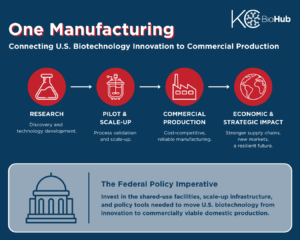
University research infrastructure can help establish proof of concept and support early process development, but that support often ends before a technology is ready for reliable production at larger volumes. At this stage, emerging companies may not yet have the funding or validated processes needed to attract for-profit contract development and manufacturing organizations (CDMOs), which generally need projects to be sufficiently mature and large to justify the cost of taking them on. Building and operating commercial facilities is a much larger investment, leaving a gap between research infrastructure and commercial capital expenditure. This is the scale-up valley of death, where promising technologies can stall because they need pilot and demonstration capacity before they are ready to attract commercial manufacturing partners or investment.
National policy has increasingly acknowledged the importance of addressing this gap. The National Security Commission on Emerging Biotechnology (NSCEB) recommended establishing a national network of precommercial bioindustrial scale-up facilities as part of a broader effort to strengthen U.S. biotechnology capabilities. Its recommendations call for the Department of Energy (DOE) and Department of Commerce to develop a network of shared-use facilities where companies can scale up production and demonstrate that bio-based fuels, chemicals, and materials can be manufactured reliably and economically. Unlike in pharmaceuticals, where precommercial development is often tied to the path toward regulatory approval, bioindustrial companies must bridge the gap between laboratory success and viable commercial production, often requiring substantial investment in pilot and demonstration-scale facilities before they can build full-scale manufacturing capacity. The commission recognized that the U.S. has some of the underlying advantages needed to scale industrial biotechnology, yet companies still take scale-up activities abroad. Legislative efforts, like the Bioindustrial Scale-Up for Supply Chains and Energy Resiliency Act of 2026, have begun to address this gap by proposing support for full production of biotechnology products that can strengthen energy resilience. These efforts reflect a growing recognition that domestic biotechnology leadership depends on the ability to manufacture products, and not simply develop them.
These developments provide an important foundation, but their impact will depend on what follows. With the NSCEB’s statutory authority set to expire at the end of 2026, the federal government needs a way to carry its recommendations into implementation. Its work has helped establish the national imperative; the next phase requires an implementation strategy that identifies where capacity is needed, who will develop it, and how companies will access and sustain it. Without that follow-through, the U.S. risks repeating a familiar pattern in which strategic priorities are clearly articulated but the infrastructure required to achieve them remains underdeveloped.
The National Strategy Requires Regional Execution
Developing a functional biomanufacturing ecosystem requires considerably more than identifying a facility gap or providing capital construction. Manufacturing infrastructure must be designed around the processes it will support, staffed by people with the appropriate technical expertise, and connected to suppliers and companies that can use its capabilities. Facilities also need operating models that make them accessible and financially sustainable over time. A pilot-scale plant that lacks the right equipment, technical support, or customer pipeline will do little to move technologies toward commercial production, regardless of the initial public investment.
Federal policy can establish national priorities and provide catalytic funding, but the work of assembling the infrastructure needed to achieve those goals takes place in regions. Regional ecosystems bring together the research institutions, manufacturers, suppliers, workforce, and companies needed to turn investment into productive capacity. They also identify specific manufacturing gaps and determine where shared facilities would serve multiple companies more efficiently than individual investments. Federal policy should build on this regional role by directing more support toward the physical infrastructure needed to resolve strategic manufacturing bottlenecks. Investments in non-physical infrastructure, including workforce development, remain important complements to physical infrastructure, but they cannot substitute for access to pilot and demonstration facilities. The goal should be to give companies a practical route from technology development to production without requiring each one to finance its own manufacturing infrastructure.
This approach would allow the federal government to support a more distributed domestic manufacturing system. Not every region needs to develop every capability, and duplicating infrastructure without a clear understanding of demand would be an inefficient use of public resources. Instead, federal investments should help regions develop complementary specializations and establish connections that allow companies to access capabilities across the country. The objective is to build a network of productive manufacturing assets that collectively strengthen domestic capacity, rather than a collection of regional initiatives that operate largely independently.
Kansas City is Already Building the Model
Kansas City offers a useful example of how regional ecosystems can begin to translate this approach into practice. Through KC BioHub, the region is developing capabilities that connect advanced biomanufacturing, supply-chain resilience, workforce development, and commercialization. Its approach is focused on building the infrastructure and institutional relationships that help companies move technologies toward production.
The SCALE Center is central to this effort. The Center will advance biomanufacturing processes toward production-ready systems to address the stage of development where companies often encounter significant technical and financial barriers. Access to specialized equipment and process-development capabilities can be particularly valuable for emerging companies that cannot justify the cost of establishing their own pilot-scale operations. Shared infrastructure can give these companies an opportunity to demonstrate and refine their processes before making the larger investments required for commercial production.
The SCALE Center is part of a broader effort to address the conditions needed for a productive regional manufacturing ecosystem. KC BioHub’s BioSupply Crossroads initiative focuses on vulnerabilities in the supply chains that support biotechnology and biomanufacturing. Its EPIC efforts strengthen connections across domestic pharmaceutical development and manufacturing, while workforce initiatives help prepare the technical talent needed to operate these capabilities. These efforts are complementary; a facility is only useful if companies can access it, the necessary inputs are available, and people have the skills to operate its equipment and support its process. By developing these capabilities together, KC BioHub is working to address the barriers that can prevent promising technologies from reaching production.
Attracting biotechnology companies and strengthening partnerships can help establish a sector’s presence, but the long-term value of those efforts depends on whether companies can access the capabilities needed to grow. KC BioHub is working to build those capabilities into the regional ecosystem, positioning Kansas City to serve as more than a center for biotechnology activity. Its potential lies in helping companies overcome practical manufacturing barriers and connecting them with the entire ecosystem needed to advance their technologies.
There may also be opportunities to expand this model into additional areas of production, including pilot-scale precision fermentation. Companies developing bio-based chemicals, materials, ingredients, and other products often need access to intermediate production capacity to demonstrate process performance and establish commercial viability. Developing additional capacity in Kansas City could help address these needs, provided investment decisions are grounded in an assessment of existing regional assets, industry demand, and the specific capabilities that remain unavailable. The priority should be to fill identifiable gaps in the manufacturing system rather than build facilities without a clear pathway to utilization.
Kansas City’s experience offers a broader lesson for federal policy. Regional ecosystem development and direct investment in strategic infrastructure should reinforce one another. Strong partnerships, workforce programs, and supply-chain connections help ensure that facilities are used and sustained, while targeted capital funding gives regions the physical capacity to move technologies toward production. Federal programs should support both, connecting ecosystem development with investments that address clearly identified manufacturing gaps.
FY27 is an Opportunity to Rethink the Tech Hubs Model
The reauthorization of the Economic Development Administration’s (EDA) Regional Technology and Innovation Hubs program in FY27 presents an opportunity to address this challenge through an existing federal mechanism. The Tech Hubs program was designed to strengthen regional technology ecosystems by supporting technology maturation, infrastructure, workforce development, and entrepreneurship. Those priorities align with many of the needs of the bioeconomy, but the program’s funding to date has been insufficient to address the capital requirements of strategic biomanufacturing infrastructure at the scale necessary.
The CHIPS and Science Act authorized $10 billion over five years for the Tech Hubs program, but by July 2026, Congress had appropriated just over $1.1 billion. The gap between the original authorization and actual funding limits what the program could have delivered. For biomanufacturing, one of the biggest challenges is the cost of building and operating pilot-scale facilities. Most early-stage companies cannot afford to build their own, yet they need access to this infrastructure to test production processes at larger volumes and prepare for commercial manufacturing. Without it, promising technologies can struggle to move beyond the lab. FY27 reauthorization is a chance to make scale-up facilities a clear priority and give regional hubs the support to build them.
To accomplish this, Congress should use the FY27 reauthorization to establish a more targeted investment pathway within Tech Hubs for capital-intensive biomanufacturing scale-up. This type of targeted funding would connect ongoing federal programs, like DOE programs funding scale-up and demonstration bio-based fuels and products, to regional manufacturing infrastructure, particularly where existing programs do not provide a clear route to shared-used facilities or sustained regional capacity. A dedicated Tech Hubs track could help fill that gap by financing infrastructure as part of a broader regional manufacturing strategy.
This track should provide larger, multi-year investments in shared-use pilot and demonstration facilities, with awards sized to the capital requirements and strategic value of each project. Funding should support the equipment and facilities needed to move technologies through scale-up, while linking those investments to workforce development, supply chain capabilities, and a credible pipeline of companies ready to use the infrastructure. Applicants should identify the manufacturing bottleneck they intend to address, demonstrate industry demand, and explain how the facility will operate and remain accessible after the initial federal investment. This would help ensure that public funding supports infrastructure with a clear purpose and a viable path to sustained use.
This would give Tech Hubs a more direct role in addressing the physical constraints on strategic industries. It would also create a clearer connection between federal economic-development spending and the manufacturing capacity the country needs. Regions would still be responsible for building partnerships and developing their workforce, but those efforts would be tied to a defined objective of bringing usable infrastructure online and helping companies move technologies toward production.
Moving From Blueprint to Manufacturing Capacity
The next phase of U.S. biomanufacturing policy should be judged by whether it closes the gap between technology development and commercial production. The NSCEB has identified the need for a national network for scale-up facilities, while regional initiatives such as KC BioHub are working to assemble the infrastructure and capabilities needed to make that vision practical. The remaining challenge is to ensure that federal programs can support these efforts at the scale required.
FY27 offers an opportunity to make that connection through the Tech Hubs reauthorization. A dedicated investment pathway for biomanufacturing scale-up would give Congress a way to support shared-use infrastructure while building on existing regional innovation efforts. It should be designed around clear manufacturing needs, credible industry demand, and measurable results. Kansas City and other regional ecosystems can help demonstrate how these investments translate into operational capacity and inform the development of a more coordinated national approach.
Ultimately, the effectiveness of these efforts should be measured by what companies are able to do that they could not do before. That means accessing pilot infrastructure, advancing biological processes toward production, bringing domestic manufacturing capacity online, and attracting the private investment required to sustain growth. Stronger regional networks and additional partnerships can contribute to these outcomes, but they are not substitutes for the manufacturing capacity that companies need.
The NSCEB and the border biotechnology community have established why scale-up matters to the U.S. Regions such as Kansas City are beginning to demonstrate how the necessary capabilities can be assembled. Congress now has an opportunity to connect national strategy with regional execution by making manufacturing infrastructure a more explicit priority in federal innovation policy. The measure of success and development strengths into products made at home, resilient domestic supply chains, and manufacturing capacity that can support future growth.